 |
 |
 |
| * Unsold lots available for sale at indicated reserve plus 22% buyer's commission plus postage & insurance.Loading... | First | Previous | Next | Last | Index |
| ANCIENT COINS: EARLY MEDIEVAL & ISLAMIC | ||||
| Lot | Description | Status | ||
| 10410 |
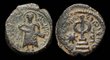
Arab-Byzantine coinage. Pre-reform period, A.H. 41-77 / A.D. 661-697. Bronze Fals (2.19g). Amman (Philadelphia) mint. Caliph standing facing, right hand resting on pommel of sheathed sword at side / Stylized cross set on three steps; star in right field. Goodwin 60 var. (star in left field); Walker, Arab-Byzantine p. 39, A4; Album 112. gVF for this very difficult and rare type. Much superior to most sold examples, especially those without the mint-name at right on the reverse. A transitional type of the early Umayyad period, struck just before the sweeping reforms of Abd al-Malik, this issue still carries strong Byzantine echoes while quietly asserting emerging Islamic authority. Struck at the Amman (Philadelphia) mint, it is a rare and appealing witness to the experimentation and regional diversity that shaped the first generations of Islamic coinage. Cf; Nomos 36/957 hammered US$450 and CNG 432/403 hammered US$525.
| AVAILABLE at A$200 | ||
|---|---|---|---|---|
| 10412 |
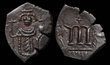
Arab-Byzantine coinage. Pseudo-Byzantine type. Circa 660s. Bronze Fals (2.53g). Standing imperial figure, holding long cruciform sceptre and globus cruciger / Large M; cross above, [A]/N/N/I to left, T/(E)/II to right, CON in exergue. Pottier et al., Pseudo-Byzantine Class IVb; A-3504. EF. Outstanding quality fals with wonderful deep dark brown patina, definitely among the finest for this very difficult issue. This fals belongs to the formative phase of early Islamic rule in former Byzantine lands, when familiar Christian imperial imagery was still retained to reassure a mixed population. Probably struck under Muawiya, before the full shift to purely epigraphic coinage, it is a powerful witness to transition, negotiated authority and coexistence between two worlds. From The Crescent Collection, previously purchased from Savoca coins (Germany) Auction301, Lot 408 Hammered US$300.
| SOLD at A$350 | ||
| 10413 |
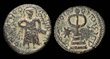
Arab-Byzantine coinage. Temp. Abd al-Malik ibn Marwan. A.H. 65-86 / A.D. 685-705. Bronze Fals (3.32g). Amman mint. Dated A.H. 74-80 / A.D. 693/4-699/700. Caliph standing facing, bearded, placing right hand on sword pommel, with whip over right elbow; legend around: li-'abd Allah Abd al-Malik amir al-mu'minin (For the servant of God, Abd al-Malik, Commander of the Faithful) / Stylized cross or standard on three steps; eight-pointed star in left field, Amman in right field; around, part of the Islamic declaration of faith: la ilaha illa Allah wahdahu Muhammad rasul Allah (There is no god but Allah alone; Muhammad is the messenger of Allah). Goodwin, Standing Caliph 150; SICA I 718. gVF. Seldom seen in this choice condition. Rare. For the type see; Leu Auction A32, lot 3297, hammered US$550. This remarkable type, struck during the key reform era of the Umayyad Caliphate, captures the shift from Byzantine imperial imagery to a distinctly Islamic visual language. Its standing caliph, still echoing late Roman and Byzantine portraiture, serves as a deliberate statement of emerging Islamic authority. Rare and much sought after, this Amman mint issue offers a vivid glimpse into the early caliphate's evolving identity and power. From the Crescent Collection; acquired from Morton & Eden Ltd., London.
| SOLD at A$375 | ||
| 10414 |
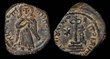
Arab-Byzantine. Temp. Abd al-Malik ibn Marwan, A.H. 65-86. Hims (Emesa). Bronze Fals (2.33g). Caliph standing facing, bearded, placing his right hand on the pommel of his sword, with whip hanging from his right elbow, legend in Kufic around / Transformed cross standing on three steps; in field to left, star; in field to right, mint bi-Hims ('in Hims' in Kufic); around, legend in Kufic. DOCAB 108; Goodwin, Standing Caliph Coinage, Hims, Type III; Goodwin & Gyselen p. 56, 54; SICA I, 691; A-3539. gVF. Undoubtedly among the finest known examples of the issue. Struck with exceptional clarity and preserved in remarkable condition. Superb piece. Ex Savoca Silver Auction 100 (April 2021), lot 476, hammered US$300.
| SOLD at A$275 | ||
| 10415 |
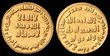
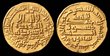
Umayyad Caliphate. Temp. Abd al-Malik. A.H. 78 (A.D. 697/8). Gold Dinar (4.23g). No mint (Damascus). Album 125; Bernardi 43. aEF. For a similar example see; Savoca 100th Silver Auction, Special Islamic Collection, hammered US$1,550. The example offered here is far superior in quality. From the Crescent Collection; acquired from Morton & Eden Ltd., London.
| SOLD at A$2500 | ||
| 10416 |
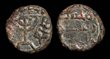
Umayyad Caliphate. Uncertain post-reform period, A.H. 77-132 / A.D. 697-750. Bronze Fals (3.21g). Menorah type. Iliya (Jerusalem) mint. La ilaha illa Allah wahdahu (There is no god but Allah alone) / In three lines: Muhammad / rasul / Allah (Muhammad, the Messenger of Allah). SICA Vol. 2, 1308-1310; Album 163.1 (R). Rare. aVF for this very difficult type. One interpretation states that the upside-down candlestick resembles the dome of a mosque. This may be the case, but the question remains: why would the Umayyads not simply depict the full image of a mosque, such as the Dome of the Rock in Jerusalem? Also, if read in that way, the text would be upside down and not easily readable, which seems unusual. The alternative interpretation, identifying the object as a Jewish menorah, appears more convincing, especially as other very rare types also depict a seven-branched candlestick. It is not surprising that early Muslims in Jerusalem might have accepted a Jewish symbol on a coin, as Jews also believe in the Oneness of God and are considered People of the Book, like Christians. The symbol could also be understood in an Islamic context, for example as an allusion to the five pillars of Islam or the seven heavens mentioned in the Quran. It is also important to note that, after nearly 500 years of exile and oppression under the Roman and Byzantine empires, Jews were allowed back into Jerusalem when the second caliph, Umar I, took the city in A.D. 637/38. It is therefore possible that, in a community where Jews had returned, the early Umayyads could have issued coins bearing a Jewish symbol. Another interpretation sees this as an unusual figural bronze struck in Jerusalem by the new Islamic rulers, with a clearly Jewish motif. The type was early identified as a menorah, although Barag noted that only one rare variety shows a true menorah with seven arms and a flat base. The object on this piece may instead resemble the Omer offering cup depicted on the silver coins of the First Jewish War, with a rounded bowl, ribbed rather than plain, a knobbed stem, and a footed base. It is possible that two different objects are represented, both connected with Jewish Temple ritual. The Jewish inhabitants of the new Arab province of Bilad al-Sham, Palestine, appear to have coexisted reasonably well with their new Islamic rulers, sharing a common opposition to the Christian Byzantine Empire. The early Umayyad caliphs were evidently willing to permit the expression of Jewish religious symbolism. For comparison see; Nomos 36, lot 957, hammered US$450, and CNG Electronic Auction 432, lot 403, hammered US$525. From the Crescent Collection; acquired from Morton & Eden Ltd., London.
| SOLD at A$210 | ||
| 10417 |
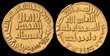
Umayyad Caliphate. Temp. al-Walid I. A.H. 90 (A.D. 708/9). Gold Dinar (4.27g). No mint (Damascus). Album 127; Bernardi 43. aEF. For a similar example see; Baldwin's Auction A27, lot 38, hammered US$1,450. From the Crescent Collection; acquired from Morton & Eden Ltd., London.
| SOLD at A$1150 | ||
| 10418 |
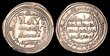
Umayyad Caliphate. Temp. al-Walid I ibn 'Abd al-Malik. A.H. 86-96 / A.D. 705-715. Silver Dirham (2.84g). Wasit mint. Dated A.H. 94 (A.D. 712/13). Klat 689; Album 128; ICV 297. Fully lustrous. Superb EF. A very attractive example. From the Crescent Collection.
| SOLD at A$140 | ||
| 10419 |
Abbasid Caliphate. Al-Ma'mun. A.H. 210 (A.D. 825/6). Gold Dinar (4.27g). Misr (Fustat) mint. Citing li'l-khalifa al-Ma'mun and Ubayd Allah b. al-Sari. Album 222.9; Bernardi 96. EF. Struck mid-reign under al-Ma'mun, this Misr issue names the local governor Ubayd Allah b. al-Sari in the margin, recording the on-the-ground authority in Egypt while affirming caliphal legitimacy in the central legends. Pieces of A.H. 210 neatly reflect the political consolidation of the province after years of unrest and are admired for their crisp, well-spaced Abbasid calligraphy. From the Crescent Collection; acquired from Morton & Eden Ltd., London.
| SOLD at A$800 | ||
| 10420 |
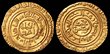
Ayyubid. Al-Mansur Muhammad. A.H. 595 (A.D. 1198/9). Gold Dinar (3.69g). Alexandria mint. Balog 228; Album 799. VF. This dinar was struck at Alexandria during al-Mansur's brief, largely nominal tenure in Egypt after the death of his father al-Aziz, and belongs to the transitional moment just before al-Adil I fully secured control. It offers a vivid snapshot of the Ayyubid handover, when authority was still being negotiated and asserted through the coinage. From the Crescent Collection; acquired from Morton & Eden Ltd., London.
| SOLD at A$750 | ||
| 10421 |
Ayyubid. Al-Adil I. A.H. 596 (A.D. 1199/1200). Gold Dinar (4.30g). Al-Qahira (Cairo) mint. Irregular edge. Balog 233; Album 801.1. VF. An early Cairo issue struck as al-Adil introduced the new centre-and-margin Kufic layout that went on to define Ayyubid dinars. From the Crescent Collection; acquired from Morton & Eden Ltd., London.
| AVAILABLE at A$750 | ||
| 10422 |
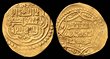
Ilkhanid. Abu Sa'id. A.H. 732 (A.D. 1331/2). Gold Dinar (6.67g). Sabzawar mint. Album 2212; Diler 525. aVF. This dinar was struck at Sabzawar in Khurasan under Abu Sa'id Bahadur Khan, only a few years before the Ilkhanate unravelled in A.H. 736. With its classic Ilkhanid layout of bold central inscription framed by margin legends, it captures the final phase of a fading dynasty, when authority still spoke clearly through the coinage even as the state itself was nearing collapse. From the Crescent Collection; acquired from Morton & Eden Ltd., London.
| SOLD at A$1050 | ||

| First | Previous | Next | Last | Index |