 |
 |
 |
| * Unsold lots available for sale at indicated reserve plus 22% buyer's commission plus postage & insurance.Loading... | First | Previous | Next | Last | Index |
| ANCIENT COINS: ROMAN (1) | ||||
| Lot | Description | Status | ||
| 10069 |
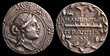
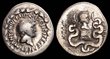
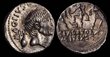
MACEDON UNDER ROMAN RULE, Amphipolis. 158-149 BC. Silver Tetradrachm (14.85g). Macedonian shield, at centre of which is a bust of Artemis Tauropolos right, with bow and quiver at her shoulder / MAKEDONON PROTES in two lines, club between, HP monogram above, ANK monogram below, all within oak wreath, to left of which a thunderbolt. S. 1386; AMNG 165 (p. 55, 4 only noted); Hunter 3 (p. 179); Mionnet Vol. I, No. 58 (p. 456). Very rare variety. Obverse slightly off centre, otherwise gVF with an amazing old cabinet toning. This tetradrachm was struck at Amphipolis in Macedon between 158 and 149 BC, during the early phase of Roman control. With Artemis Tauropolos on the obverse and the Macedonian club in oak wreath on the reverse, it neatly captures the blend of traditional Macedonian identity and the new Roman order in the region. (P)
| SOLD at A$725 | ||
|---|---|---|---|---|
| 10070 |
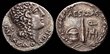
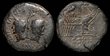
MACEDON (Roman Province). Aesillas. Quaestor, circa 95-70 BC. Silver Tetradrachm (16.50g). Uncertain mint. Head of the deified Alexander the Great right / Money chest, club and chair within wreath. AMNG III/2, 9.7; Bauslaugh, ANS NS 22, 39.11/57f (this specimen). A very attractive old cabinet collection toning, obverse slightly off centre, otherwise excellent style for the series and struck in high relief. aEF. This tetradrachm was struck in Macedonia in the name of Aesillas the Quaestor around 95-70 BC, at a moment when Roman power was taking firm hold in the region. Although it carries Latin titles and Roman symbols of office such as the curule chair and sceptre, it follows the familiar Hellenistic tetradrachm format to ensure acceptance among a Greek-speaking populace. As such it stands as a clear illustration of Rome's early administrative presence in the East, blending imperial authority with a measured respect for Macedonian tradition. (P)
| SOLD at A$750 | ||
| 10071 |
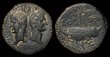
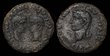
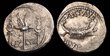
GAUL, Nemausus. Augustus, with Agrippa. 27 BC-A.D. 14. Bronze Dupondius (12.36g). Struck circa 9/8-3 BC. Heads of Agrippa left, wearing rostral crown and laurel wreath, and Augustus right, wearing laurel wreath, back to back / Crocodile right chained to palm frond with short fronds; wreath with long ties above, palm fronds below. RPC I 524; SNG Copenhagen 699. Attractive dark green-brown patina. VF. Exceptional for the type. (P)
| SOLD at A$525 | ||
| 10072 |
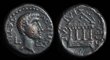
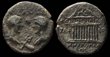
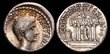
JUDAEA, Herodians. Herod IV Philip. 4 BC-A.D. 34. Bronze (6.26g). Caesarea Philippi (Panias) mint. Dated RY 5 (A.D. 1/2). Bare head of Philip right; L E (date) across lower field / Tetrastyle temple, the Augusteum of Panias, set on podium with two steps. Meshorer 96; Hendin 6251; RPC I 4939; Sofaer -. Dark brown surfaces, repatinated. VF. Extremely rare. Herod Philip, tetrarch of Iturea and Trachonitis and son of Herod the Great, governed a largely non-Jewish population centred on Panias at the foot of Mount Hermon. There he refounded the city as Caesarea Philippi and presided over a sanctuary complex dominated by the grotto of Pan and a marble Augusteum to the Roman emperor. It is in this cultural setting, imperial cult and Hellenised civic life, that Philip could break with Judaean tradition and place his own portrait on coins. As Hendin observes (p. 257), 'Philip was able to immortalize his face on his coins largely because so few Jews lived in the territories over which he ruled,' since a portrait would have been viewed by observant Jews as a 'graven image.' The present issue dates to Regnal Year 5 (L E = A.D. 1/2), still in the reign of Augustus, and pairs Philip's bare head with the facade of the Augusteum, a clear statement of loyalty to Rome and of the city's identity. The temple, shown tetrastyle on a two-step podium, evokes the sacred topography of Panias while advertising the imperial cult that anchored Philip's regime. Surviving examples are few and typically worn or corroded; this piece, with dark brown surfaces, a bold portrait, and a well-defined temple, is an especially choice representative of an extremely rare type linking Herodian rule, Roman authority, and the distinctive religious landscape of Caesarea Philippi. For the type and similar quality see; CNG Auction 114, lot 525, hammered USD 8,500. (P)
| SOLD at A$1000 | ||
| 10073 |
KINGS OF THRACE. Rhoemetalces I and Pythodoris, with Augustus. Circa 11 BC-A.D. 12. Bronze (9.52g). Jugate heads of Rhoemetalces and his queen Pythodoris right / Bare head of Augustus right. RPC I 1711; Youroukova 204. The finest known for this interesting issue, with wonderful green patina and subtle greenish sandy highlights. Well detailed and well struck for the issue. A truly exceptional piece. gEF. (P)
| SOLD at A$375 | ||
| 10074 |
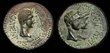
SPAIN, Hispalis. Tiberius, with Germanicus and Drusus Caesars. A.D. 14-37. Bronze As (17.63g). Laureate head of Tiberius left / Confronted bare heads of Germanicus and Drusus. ACIP 3361; RPC I 74. VF. A very pleasing coin, quite good for the type. (P)
| SOLD at A$210 | ||
| 10075 |
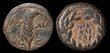
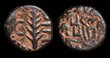
JUDAEA, Procurators. Valerius Gratus. A.D. 15-26. Bronze Prutah (1.98g). In the names of Tiberius and Julia Augusta (Livia). Jerusalem mint. Dated RY 5 of Tiberius (A.D. 18/9). TIB/KAI/CAP in three lines within wreath / Palm frond; IOYLIA and L (E) (date) across field. Meshorer 328; Hendin 6368; RPC I 4965. VF. Exceptional for this very difficult issue. This prutah is more than a modest bronze; it is a concise record of Rome's rule in Judaea. Struck under the governor Valerius Gratus in honour of Julia Augusta (Livia), it circulated in a province where Roman power was tolerated more than welcomed, serving as both small change and a daily reminder of imperial presence. In this well-preserved state, it offers a rare, tangible glimpse into early imperial policy and provincial tension.
| SOLD at A$120 | ||
| 10076 |
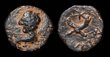
JUDAEA, Herodians. Agrippa I, with Agrippa II. A.D. 37-43. Bronze (1.42g). Caesarea Paneas mint. Dated RY 5, A.D. 40/1. Diademed bust of Agrippa II right; [LE date to left] / Crossed cornucopiae. Meshorer 119 (Tiberias mint); Hendin 1243; RPC I 4979. gF. Earthen dark green-brown patina. Very rare. For the type and a lower-quality example see; CNG Auction 118, lot 524, hammered US$800. This rare Caesarea Paneas issue from Agrippa I's fifth regnal year reflects the Herodian dynasty's close alignment with Rome while showing how portrait coinage could be used in a largely non-Jewish city, unlike Jerusalem where aniconic traditions prevailed. The series, naming figures from both the Herodian and imperial families, offers a vivid glimpse into the political and cultural balance of early 1st century Judaea. (P)
| AVAILABLE at A$200 | ||
| 10077 |
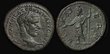
EGYPT, Alexandria. Claudius. A.D. 41-54. Billon Tetradrachm. Dated RY 2, A.D. 41/2. Laureate head right; LB (date) to right / Messalina standing left, leaning on column right, holding two children in outstretched hand and cradling grain ears. RPC I 5115; Dattari (Savio) 121; K&G 12.5. NGC VF, with edge chip. This tetradrachm presents an arresting dynastic portrait type for Messalina, Claudius' third wife, whose appearance on Alexandrian coinage sits in sharp contrast to her later downfall and execution in A.D. 48 after allegations of conspiracy at court. Ex Stack's Bowers Galleries, June 2020 Collector's Choice World Auction, lot 72068 (24 June 2020), hammered USD 180.
| SOLD at A$170 | ||
| 10078 |
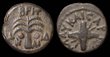
JUDAEA. Claudius. A.D. 41-54. Bronze Prutah (2.93g). Jerusalem mint. Antoninus Felix, procurator. Dated RY 14, A.D. 54. Two oblong shields and spears crossed / BPIT KAI, six-branched palm tree bearing two bunches of dates; L I(A) (date) across field. Hendin 6377 (this coin illustrated); TJC 340; RPC I 4971. gVF. Exceptional for the type. (P)
| SOLD at A$120 | ||
| 10079 |
IONIA, Smyrna. Britannicus. A.D. 41-55. Bronze (4.18g). Philistos and Eikadios, magistrates. Bareheaded and draped bust right / Nike standing right, holding trophy over shoulder. Klose type XXXI; RPC I 2476 (Nero). gVF. Dark green-brown patina. Attractive for the issue. This is a genuinely intriguing type, RPC records only 92 examples. Even the portrait is debated; Klose identified the head as Britannicus, while the RPC editors argue it is Nero, and either interpretation is believable. If it is Britannicus, the backstory is dramatic: he was the son of Claudius and Messalina, born about A.D. 41-42, and in A.D. 55 he was poisoned as Agrippina the Younger cleared the way for Nero's rule. For the type see; CNG 490, lot 82, hammered US$1,400. (P)
| SOLD at A$725 | ||
| 10080 |
EGYPT, Alexandria. Nero, with Poppaea. A.D. 54-68. Billon Tetradrachm (13.80g). Dated RY 11 (A.D. 64/5). Radiate head of Nero right / Draped bust of Poppaea right; L IA (date) before. Koln 168-9; Dattari (Savio) 197-8; K&G 14.85; RPC I 5280; Emmett 128.11. A very attractive deep old cabinet toning. (P)
| SOLD at A$625 | ||
| 10081 |
JUDAEA, Jerusalem. Procurators. Porcius Festus. A.D. 59-62. Bronze Prutah (2.76g). Irregular issue. Palm frond / Illegible inscription within wreath. Cf. TJC 345l. VF. A highly unusual and enigmatic issue from the brief procuratorship of Porcius Festus, successor to Antonius Felix. Clearly struck in Jerusalem, this irregular type diverges from standard Festus issues in both execution and style. The palm frond remains clear, while the largely illegible reverse inscription may indicate local or unofficial production. Scarce and intriguing, especially for collectors focused on Roman provincial Judaea. Ex Savoca 243, lot 181, hammered US$200. (P)
| SOLD at A$190 | ||
| 10082 |
SELEUCIS AND PIERIA, Antioch. Otho. A.D. 69. Bronze As (7.14g). Gaius Licinius Mucianus, legatus Syriae. Dated Year 117 of the Caesarean era (A.D. 69). Laureate head right / Date in five lines within laurel wreath. McAlee 317; RPC I 4316. Attractive dark brown patina. gVF. A choice example for this very rare type. This bronze As proclaims Otho's fleeting authority in the East under the powerful legate Gaius Licinius Mucianus. The laureate portrait asserts the new emperor's legitimacy, while the distinctive five-line civic date within a laurel wreath anchors the issue firmly in the Caesarean era of Antioch, linking local chronology with imperial power. For the type see; Leu Auction 7, lot 1489, hammered USD 1,800. (P)
| AVAILABLE at A$1000 | ||
| 10083 |
LYCIA, Lycian League. Nerva. A.D. 96-98. Silver Drachm (3.69g). Dated A.D. 97. AYTOKPAT NEPOYAC KAICAP CEBACT, laureate head of Nerva right; L-Y across fields / YPATOY TPITOY, owl perched on two lyres. BMC 8; RPC III 2673; SNG Copenhagen 44; SNG von Aulock 4266. A boldly struck and very attractive example, with fine iridescent toning. Struck from a slightly worn reverse die, otherwise about Extremely Fine. From the Titan Collection; acquired from the David Allen Collection, previously from the Coppenolle Collection; acquired from Noble Numismatics, Sale 86, Sydney, 21-23 November 2007.
| SOLD at A$300 | ||
| 10084 |
Plotina, wife of Trajan. Augusta, A.D. 98-117. Bronze (4.05g). Phrygia, Ancyra. Loukios, magistrate. PLOTEINA SEBASTE, draped bust right / ANKYRANON EPI LOUKIOU, cult statue of Artemis Ephesia flanked by two stags. RPC III 2536; BMC Phrygia 21. aVF for the type. Very rare. From the Collection of David Allan; acquired from CNG, 1 Jan 2002, ticket no. 87342; noted at the time as a possibly unique piece. (P)
| SOLD at A$130 | ||
| 10085 |
EGYPT, Alexandria. Hadrian. A.D. 117-138. Billon Tetradrachm (13.47g). Dated Regnal Year 16, A.D. 131/2. AVT KAIC-TPAI ADPIA CEB, laureate, draped and cuirassed bust of Hadrian right, seen from behind / Serapis enthroned left, holding grounded sceptre in left hand and extending right hand toward Cerberus seated at his feet. L I-S across fields. RPC III 5789. Well centred and well defined for the type. Superb attractive patina. aEF. Acquired from I. S. Wright in the early 2000s. This tetradrachm was struck at Alexandria during the sixteenth regnal year of Hadrian, one of the most widely travelled and intellectually ambitious emperors of Rome. Born in A.D. 76 and connected by family ties to Trajan, he rose through a distinguished public and military career before succeeding to the throne in A.D. 117. Rather than continue Trajan's eastern expansion, Hadrian reshaped the empire through consolidation, reform, and direct imperial presence, personally visiting provinces across the Roman world. Under his rule, Roman culture, architecture, and administration reached a refined and enduring high point. (P)
| SOLD at A$220 | ||
| 10086 |
EGYPT, Alexandria. Hadrian. A.D. 117-138. Billon Tetradrachm (13.79g). Dated RY 12, A.D. 127/8. Laureate, draped and cuirassed bust right, seen from behind / Two clasped right hands; L IB (date) above and below. Koln 979-80; Dattari (Savio) 1524; K&G 32.459; RPC III 5715; Emmett 848.12. Toned, with traces of deposits. gVF. (P)
| SOLD at A$450 | ||
| 10087 |
EGYPT, Alexandria. Hadrian. A.D. 117-138. Billon Tetradrachm (13.74g). Dated Regnal Year 19, A.D. 134-135. AUT KAIC TRAIAN ADRIANOC CEB, laureate head of Hadrian left / L EN-NEAK D, draped bust of Sarapis right, wearing kalathos. Dattari (Savio) 1465; Geissen 1150; K&G 32.621; RPC III 5943. Wonderfully toned and well centred. aEF. (P)
| SOLD at A$375 | ||
| 10088 |
LYDIA. Sala. Hadrian, A.D. 117-138. Bronze Diassarion (7.62g). C. Val. Androneikos, magistrate. AY KAI ADRIANOC, laureate, draped and cuirassed bust of Hadrian right, seen from behind / EPI G OYAL ANDPONEIKOY CALHNON, Zeus Lydios standing facing, head left, holding eagle in his right hand and sceptre in his left. RPC III 2442; BMC 31-32. Dark green-brown patina with attractive earthen highlights. A superb example, apparently among the finest known. gEF. For a similar example in comparable quality, see Leu Auction 14, lot 977, 12 December 2020, hammered CHF 200, approximately AUD 375. The present coin is clearly finer, with far better centering and sharper details. (P)
| SOLD at A$180 | ||
| 10089 |
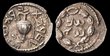
Judaea, Bar Kokhba Revolt. Silver Zuz (2.97g), A.D. 132-135. Undated, attributed to Year 3 (A.D. 134/5). 'Shim'on' (Paleo-Hebrew) within wreath of thin branches wrapped around eight almonds, with medallion and tendrils / 'For the freedom of Jerusalem' (Paleo-Hebrew), fluted jug with handle on left; willow branch in right field. Hendin 1422; Mildenberg 89.2 (O15/R58; this coin); TJC 283a. Extremely rare, only three specimens cited by Mildenberg, this being the one selected to illustrate the dies. Wonderfully toned. gVF. The jug and willow branch refer to the water libation ceremony of Sukkot, once performed at the Jerusalem Temple. Struck decades after the Temple?s destruction in A.D. 70, this imagery became a powerful symbol of memory, faith and resistance, recalling a sacred ritual that could no longer be performed while proclaiming the rebels? hope for Jerusalem?s freedom. (P)
| SOLD at A$3300 | ||
| 10090 |
BITHYNIA, Nicaea. Macrinus. A.D. 217-218. Bronze Diassarion (13.70g). Laureate head right / Serapis standing facing, head left, holding grain ears and sceptre. Recueil General 536 var. (bust variety); SNG Copenhagen 510 var. (same); BMC 166.89 var. (same); SNG von Aulock unlisted. Bust variety and reverse legend not recorded in the standard references. Extremely rare. VF. (P)
| SOLD at A$150 | ||
| 10091 |
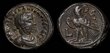
EGYPT, Alexandria. Valerian I. A.D. 253-260. Potin Tetradrachm (11.36g). Dated Regnal Year 5, A.D. 257/8. Laureate and cuirassed bust right, seen from the front / Eagle standing left, head and tail right, holding wreath in beak; L E across field. Koln 2868; Dattari (Savio) 5185; K&G 88.29; Emmett 3705.5. Dark brown patina with traces of red. Well struck. gVF.
| SOLD at A$150 | ||
| 10092 |
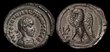
EGYPT, Alexandria. Macrianus. Usurper, A.D. 260-261. Potin Tetradrachm (11.89g). Dated RY 1 (A.D. 260/1). Laureate and cuirassed bust right, seen from the front / Eagle standing left, wings displayed, holding wreath in beak; L A (date) to lower left. Koln 3011; Dattari (Savio) 5380; K&G 94.1; Emmett 3785.1. Wonderful toning. An incredible example and undoubtedly the finest known. gEF. This tetradrachm comes from the brief Macrian interlude of A.D. 260-261, after Valerian's capture by Shapur I threw the East into crisis. Macrianus Senior rallied the armies and pushed the Persians back beyond the Euphrates with the help of Callistus Ballista, then declined the throne and raised his sons Macrianus and Quietus as emperors. Alexandria struck local potin tetradrachms for the new regime, but the attempt collapsed almost immediately; Macrianus was killed in the West, while Quietus and Ballista fell soon after in Syria, ending the dynasty within months. For a recently sold example see; Kolner Auction A122, lot 893, hammered USD 550. (P)
| SOLD at A$700 | ||
| 10093 |
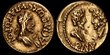
KINGS OF THE BOSPOROS. Eupator, with Marcus Aurelius and Lucius Verus. Electrum Stater (7.76g). Dated Bosporan Era 459 = A.D. 162/3. Diademed and draped bust of Eupator to right; club before / Head of Marcus Aurelius to left, facing draped bust of Lucius Verus to right, pellet between; ONV (date) below. RPC IV.1 3742 (temporary); Frolova pp. 160-161; MacDonald 469/1. Reverse off-centre. gVF. (P)
| SOLD at A$1250 | ||
| 10094 |
CILICIA, Tarsos. Commodus and Annius Verus. A.D. 161-165. Bronze (3.72g). Confronted busts of Commodus and Annius Verus as the Dioskouroi; star, caduceus and club between / Dekastyle temple. SNG Paris 1456 (same obverse die). VF, with green patina. Very rare. From the David Allan Collection; previously from the David Tong Collection; acquired from CNG Auction 55 (24 September 1997), lot 1027. (P)
| AVAILABLE at A$200 | ||
| 10095 |
Commodus. A.D. 177-192. Billon Tetradrachm (12.11g). Alexandria mint. Dated regnal year 28 of Marcus Aurelius, A.D. 187/8. Laureate head right / Commodus standing facing, head left, holding olive branch and sceptre; to right, Alexandria facing, turreted, crowning Commodus and holding two grain ears; L K H (date) across field. Koln 2230; Dattari-Savio 3854; K&G 41.92; Emmett 2537.28. A choice example for the type. A very attractive dark brown-green patina. gVF. (P)
| SOLD at A$100 | ||
| 10096 |
SELEUCIS AND PIERIA, Laodicea ad Mare. Septimius Severus. A.D. 193-211. Silver Tetradrachm (12.43g). Struck A.D. 208-209. Laureate and draped bust right / Eagle standing facing, head left, with wings spread, holding wreath in beak; star between legs. Prieur & Amandry Group III, 34a; McAlee, Severan, Group III, 25; Prieur 1149. Attractive old grey cabinet toning with hints of light golden lustre. aEF. An incredible example. (P)
| SOLD at A$275 | ||
| 10097 |
Zenobia. Usurper, A.D. 268-272. Potin Tetradrachm (6.65g). Alexandria mint. Dated RY 5 of Vaballathus, A.D. 272. CEPTIM ZHNOBIA CEB, draped bust right, wearing stephane / Homonoia standing facing, head left, raising right hand and holding double cornucopia; L E in left field. Koln -; Dattari (Savio) 5512 (this coin); K&G 108.2; Emmett 3912.5 (R2); Staffieri, Alexandria in Nummis 247 (this coin). Dark brown patina with traces of green. gVF for this difficult and very rare issue, and clearly better than most examples seen on CoinArchives. An absolutely choice coin for the type. Septimia Zenobia, widow of Odenathus of Palmyra, became the real power in the East after his assassination around A.D. 267. Ruling as regent for her young son Vaballathus, she used the wider instability of the period to push Palmyra outward, carefully navigating between Rome and Persia. In A.D. 269, her forces took Egypt, bringing the grain supply under Palmyrene control and turning a regional power into a direct challenge to Rome. Ancient sources also say she claimed prestigious ancestry, linking herself to figures such as Cleopatra VII and the legendary Dido. When Aurelian came to the throne in A.D. 270, he first focused on the West and, for a time, tolerated Zenobia's position. In A.D. 272, he moved against Palmyra, sacked the city, and captured Zenobia and Vaballathus as they tried to escape toward Persia. She was taken to Rome and shown in Aurelian's triumph in A.D. 274, and later tradition places her in retirement at Tibur. (P)
| SOLD at A$1900 | ||
| 10098 |
CILICIA, Tarsus. Caracalla. A.D. 198-217. Bronze (17.70g). Laureate head right / Roma seated left, holding Nike and spear; shield resting on ground behind. SNG Levante -; SNG Levante Suppl. 263 (this coin); SNG France 1489 (same dies); SNG von Aulock -. gVF. With a wonderful green patina and earthen highlights. From the inventory of I. S. Wright, acquired from Classical Numismatic Group, Mail Bid Sale 66 (19 May 2004), lot 1182; among the finest examples to have appeared since.
| SOLD at A$325 | ||
| 10099 |
Uranius Antoninus. Usurper, A.D. 253-254. Billon Tetradrachm (10.95g). SYRIA, Seleucis and Pieria. Emesa. Laureate, draped and cuirassed bust right / DHMARX EXOVCIAC VPA TO B, eagle standing facing, head and tail left, wings displayed, holding wreath in beak; S C beneath wings. Baldus - (dies XVIII/- [unlisted reverse die]); cf. Prieur 1044; cf. CNG 58, 963. VF, with black-green patina and earthen undertones. Unlisted. Extremely rare variety. Uranius Antoninus is a shadowy figure of the mid third century, unknown to the main ancient historians and glimpsed almost entirely through his coinage. Active at Emesa in Syria around A.D. 253-254, he appears to have been a local priest-king of the sun god who assumed imperial trappings in response to repeated Persian attacks, rather than as a direct challenger to Rome. His coins give him the elaborate name Lucius Julius Aurelius Sulpicius Severus Uranius Antoninus and often feature local temple types, underlining his regional power base and religious role. Later writers, such as Zosimus, seem to confuse him with other usurpers bearing similar names, which has only added to the uncertainty around his career. What can be said with some confidence is that his authority was short-lived and was probably extinguished when Valerian advanced east to restore imperial control, leaving Uranius Antoninus as one of the more enigmatic protagonists of the crisis-ridden third century, preserved for us almost solely through his rare and historically important coins. From the Titan Collection; previously from the David Allan Collection, acquired from Classical Numismatic Group, Auction 88, 14 September 2011, lot 1030, hammered US$3500. (P)
| SOLD at A$3500 | ||
| 10100 |
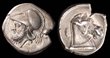
Anonymous. Circa 300/280-276 BC. Silver Didrachm (7.04g). Uncertain (Neapolis?) mint. Helmeted head of Mars left; oak spray to right / Horse's head right, wearing bridle, on base inscribed ROMANO; stalk of grain to left. Crawford 13/1; Burnett 18 (Oc/R12); Sydenham 1; RSC 4; cf. RBW 3 (for type). Very rare and in unusually fine condition for this very difficult issue. gVF. This didrachm, struck during a turbulent period of transition in Magna Graecia, captures the uncertainty and fluidity of power in Southern Italy around 300-276 BC. Without a magistrate's name or city ethnic, the coin reflects a moment when civic identity may have been intentionally understated, possibly due to external threats or internal reforms. The anonymity could suggest an emergency issue, regional alliance, or military campaign where the emphasis was on shared purpose rather than local pride. These enigmatic pieces offer a fascinating glimpse into a time when Greek cities in Italy balanced tradition with the pressures of shifting alliances, war, and the rising shadow of Rome. (P)
| SOLD at A$3500 | ||
| 10101 |
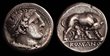
Anonymous. Circa 264-255 BC. Silver Didrachm (6.24g). Rome mint. Diademed head of beardless young Hercules right, wearing lion skin around neck; club on shoulder / She-wolf standing right, head left, suckling the twins, Romulus and Remus; ROMANO in exergue. Crawford 20/1; Sydenham 6; HN Italy 287; RSC 8; BMCRR Romano-Campanian 28; Kestner 38-9; RBW 23. Toned, with minor marks and traces of deposits. gVF. Attractive old cabinet toning. Comparable in quality to the recently sold example in Triton XXVII, lot 564 (9 January 2024), hammered USD 4,375, this is a particularly beautiful example for the type. (P)
| SOLD at A$4000 | ||
| 10102 |
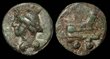
Anonymous. Circa 225-217 BC. Bronze Aes Grave Sextans (38.69g). Rome mint. Head of Mercury left, wearing winged petasus; mark of value below / Prow of galley right; mark of value below. Crawford 35/5; ICC 81; HN Italy 341; RBW 89. Pale green patina. aVF. One of the finest known examples for this type. For the type see; CNG Electronic Auction 452, lot 657, hammered US$950. From the David Allen Collection. (P)
| SOLD at A$475 | ||
| 10103 |
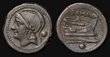
Anonymous. Circa 217-215 BC. Bronze Uncia (12.63g). Rome mint. Helmeted head of Roma left; (.) mark of value to right / Prow of galley right; (.) mark of value below. Crawford 38/6; Sydenham 86. EF. Excellent centring and strike, with an attractive green patina. This piece is undoubtedly among the very finest known for the type, a level of preservation that is rarely seen and extremely hard to find, and is far superior in quality to the most recently sold example, CNG Auction 563 (5 June 2024), lot 653, which realised USD 475. (P)
| SOLD at A$425 | ||
| 10104 |
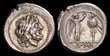
Anonymous. 211-208 BC. Silver Victoriatus (3.30g). Uncertain mint in Sicily. Laureate head of Jupiter right / Victory standing right, crowning trophy; ROMA in exergue. Crawford 70/1; cf. Crawford, Early 195 (for type); Schaefer & Friedman, fig. 14; Sydenham 83; RSC -; Kestner -; BMCRR Italy 139; cf. RBW 297 (for type). Well centred and attractive for the issue. VF. For the type see; Triton XX, lot 492, hammered US$9,500. This anonymous Victoriatus from an uncertain Sicilian mint reflects Rome's practical approach to managing newly conquered territories. Struck on a lighter silver standard and clearly aimed at Greek-speaking areas like Sicily, it was designed to feel familiar to local users accustomed to Greek-style coinage. Its lack of moneyer's name highlights a transitional phase, with Rome prioritising stability and trust in the currency over individual prestige. As such, it is a quietly powerful piece of evidence for how Rome used money as a tool of occupation, integration, and diplomacy. (P)
| SOLD at A$275 | ||
| 10105 |
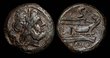
Anonymous. After 211 BC. Bronze Semis (18.01g). Unmarked series. Uncertain mint. Laureate head of Saturn right; S (mark of value) to left / Prow of galley right; S (mark of value) above. Crawford 56/3; Sydenham 143a; RBW 203-4. Greenish-brown patina. VF. (P)
| SOLD at A$210 | ||
| 10106 |
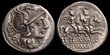
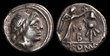
Q. Marcius Libo. 148 BC. Silver Denarius (3.89g). Rome mint. Helmeted head of Roma right; X (mark of value) below chin / The Dioscuri, each holding spear, on horseback riding right. Crawford 215/1; Sydenham 395; Marcia 1; RBW 915. Very attractive old cabinet toning. This denarius ties an old Roman family to the city's legendary protectors. Roma's helmeted head recalls the Republic's stern virtues, while the Dioscuri gallop across the reverse, symbols of divine aid said to have turned the tide at the Battle of Lake Regillus. In everyday trade, this coin quietly reminded its holder that Rome's power rested on courage, tradition and the favour of the gods. (P)
| SOLD at A$400 | ||
| 10107 |
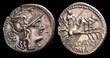
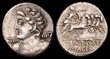
C. Aburius Geminus. 134 BC. Silver Denarius (3.82g). Rome mint. Head of Roma right, wearing winged helmet, ornamented with griffin's head, the visor in three pieces, single-pendant earring and pearl necklace; GEM to left, mark of value below chin / Mars, holding trophy in right hand and spear, shield and reins in left, driving galloping quadriga right; C (AB)(VR)I below horses, ROMA in exergue. Crawford 244/1; Sydenham 490; Aburia 1; BMCRR Rome 999; Kestner 2214-5; RBW 1006. gVF. A wonderful example for the type. This denarius of C. Aburius Geminus belongs to a phase when Roman moneyers increasingly used coinage for personal and political self-promotion. As a member of the relatively obscure Aburia gens, Geminus likely used this issue to project his name and family into the public eye, turning everyday currency into a vehicle for reputation and influence. Circulating widely across the Roman world, the coin helped assert his presence within the competitive aristocratic arena and illustrates the broader shift in Republican coinage from anonymous state issues to personalised expressions of identity and ambition. (P)
| SOLD at A$400 | ||
| 10108 |
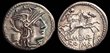
M. Marcius Mn.f. 134 BC. Silver Denarius (3.83g). Rome mint. Helmeted head of Roma right; modius to left, mark of value below chin / Victory, holding whip in right hand and reins in left, driving biga right; below, two grain ears. Crawford 245/1; Sydenham 500; Marcia 8; RBW 1009. Attractive deep old cabinet toning with vivid iridescent highlights. EF. This denarius speaks to Rome's identity as both soldier and provider. Roma appears helmeted and proud on the obverse, while on the reverse Victory urges her chariot forward above two grain ears, a reminder that military success and secure food supplies went hand in hand. In the hands of a citizen, this little silver piece was both daily money and a quiet message that Rome's strength fed her people as much as it conquered new lands.
| SOLD at A$450 | ||
| 10109 |
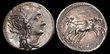
C. Claudius Pulcher. 110-109 BC. Silver Denarius (3.85g). Rome mint. Helmeted head of Roma right / Victory, holding reins, driving biga right. Crawford 300/1; Sydenham 569; Claudia 1; RBW 1143. Attractive iridescent toning. gVF.
| SOLD at A$300 | ||
| 10110 |
L. Thorius Balbus. 105 BC. Silver Denarius, brockage (4.02g). Rome mint. Head of Juno Sospita right, wearing goat-skin headdress / Incuse and reversed impression of the obverse. Cf. Crawford 316/1; cf. Sydenham 598; cf. Thoria 1; cf. RBW 1168; all for obverse type. Nicely toned. gVF. (P)
| SOLD at A$300 | ||
| 10111 |
Q. Thermus M.f. 103 BC. Silver Denarius (3.87g). Rome mint. Head of Mars left, wearing crested helmet ornamented with plume and annulet / Two warriors fighting, each armed with sword and shield; the one on the left protects a fallen comrade, while the other wears a horned helmet. Crawford 319/1; Sydenham 592; Minucia 19; RBW 1174. Exceptional rainbow iridescent toning. gVF. (P)
| SOLD at A$300 | ||
| 10112 |
L. Calpurnius Piso Frugi. 90 BC. Silver Denarius (3.96g). Rome mint. Laureate head of Apollo right, four pellets behind / Horseman galloping right, holding palm; L. PISO. FRVGI in exergue, O above. Crawford 340/1. Well struck on a bright flan, with amazing lustre and beautiful old cabinet toning. gEF. Far superior to the closest comparable example we traced, Auction 232211, lot 63204, 16 March 2022, hammered USD 360. (P)
| SOLD at A$425 | ||
| 10113 |
L. Rubrius Dossenus. 87 BC. Silver Denarius (3.88g). Rome mint. Laureate head of Jupiter right, sceptre over shoulder / Triumphal quadriga right, side-panel decorated with thunderbolt; above, Victory flying right, holding wreath. Crawford 348/1; Sydenham 705; Rubria 1; RBW 1322. Toned with traces of iridescence and golden hues. Struck on a compact flan. VF. (P)
| SOLD at A$220 | ||
| 10114 |
C. Licinius L.f. Macer. 84 BC. Silver Denarius (3.81g). Rome mint. Diademed bust of Vejovis left, drapery on left shoulder, hurling thunderbolt / Minerva driving galloping quadriga right, holding spear, reins and shield; C LICINIVS [L F]/MACER in two lines in exergue. Crawford 354/1; Sydenham 732; Licinia 16; BMCRR Rome 2467-9; RBW 1355. Almost impossible to encounter in this calibre for the type, with a remarkably well-centred strike compared to nearly all known examples. Highly attractive and alive with considerable remaining lustre. Superb EF. This denarius, issued by C. Licinius Macer at Rome in 84 BC, pairs the storm-hurling Vejovis with Minerva charging forward in a quadriga, a vivid Republican statement of divine aid and aggressive military energy under the Licinii. For the type see; Triton XXII, lot 822, hammered USD 1,100, although the present example is clearly superior in overall preservation. (P)
| AVAILABLE at A$1000 | ||
| 10115 |
P. Furius Crassipes. 84 BC. Silver Denarius (3.41g). Rome mint. Turreted head of Cybele right; to left, foot downward / Curule chair. Crawford 356/1c; Sydenham 735b; Furia 19; RBW 1361. Superb example, well centered and fully lustrous. gVF. (P)
| SOLD at A$425 | ||
| 10116 |
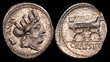
C. Mamilius Limetanus. 82 BC. Silver Serrate Denarius (4.03g). Rome mint. Draped bust of Mercury right, wearing winged petasus; to left, I above caduceus / Ulysses, wearing pileus and mariner's dress, walking right, leaning on staff and extending his hand toward his dog, Argus, who advances toward him. Crawford 362/1; Sydenham 741; Mamilia 6; RBW 1370 var. (control). Old grey cabinet toning, with underlying lustre. gVF. This denarius celebrates the proud mythical lineage of the gens Mamilia, who claimed descent from Mamilia, daughter of Telegonus, himself the son of Ulysses and the sorceress Circe, and ultimately from Mercury. The reverse shows the poignant scene from the Odyssey in which the old hound Argus, after twenty years of waiting, recognises Ulysses disguised as a beggar and greets him with a last flicker of devotion before dying. By choosing this image, the moneyer evokes both the heroic ancestry and the enduring loyalty associated with his family's legendary forebear. (P)
| SOLD at A$850 | ||
| 10117 |
Pub. Crepusius. 82 BC. Silver Denarius (3.76g). Rome mint. Laureate head of Apollo right, sceptre over shoulder; M behind, thunderbolt below chin / Warrior on horse rearing right, brandishing spear in right hand; XXXXiiii behind; P CREPVSI in exergue. Crawford 361/1c; Sydenham 738a; cf. Kestner 3146-9; cf. BMCRR Rome 2673; Crepusia 1; CNR 4/3 and 4/4. Reverse slightly off-centre, otherwise aEF. (P)
| SOLD at A$350 | ||
| 10118 |
Anonymous. 81 BC. Silver Quinarius (1.72g). Laureate head of Apollo right / Victory standing right, crowning trophy; B between. Crawford 373/1b; Sydenham 609a; RSC 227a. Old cabinet toning. gVF. (P)
| SOLD at A$200 | ||
| 10119 |
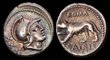
P. Satrienus. 77 BC. Silver Denarius (3.82g). Rome mint. Helmeted head of young Mars right; XXXI to left / She-wolf standing left with paw raised. Crawford 388/1b; Sydenham 781a; Satriena 1; RBW 1422 var. (control number). Toned, slightly granular, with attractive bluish hues around the head and warm golden tones across the fields, creating strong visual appeal in hand. gVF. (P)
| SOLD at A$350 | ||
| 10120 |
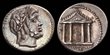
M. Volteius M.f. 75 BC. Silver Denarius (3.97g). Rome mint. Laureate and bearded head of Jupiter right / Tetrastyle temple of Jupiter Capitolinus; winged thunderbolt in pediment. Crawford 385/1; Sydenham 774; Volteia 1. Highly attractive coin, with deep cabinet grey toning and sharp details; although the reverse is slightly off-centre, it remains a truly beautiful and pleasing piece. aEF. From the David Allen Collection. (P)
| SOLD at A$575 | ||
| 10121 |
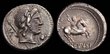
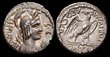
M. Plaetorius M.f. Cestianus. 57 BC. Silver Denarius (3.93g). Rome mint. Helmeted and draped bust right, with attributes of Isis, Minerva, Apollo, Diana, and Victory; cornucopiae below chin / Eagle standing right on thunderbolt with wings spread, head left. Crawford 409/1; Sydenham 809; Plaetoria 4. Lustrous and lightly toned. Superb EF. Crawford dismisses the old idea that the obverse bust shows Vacuna, following J. P. Morel's arguments (MEFR 1962, 25-29). A. Alfoldi has instead suggested Isis (SM 1954, 30-31), which may be closer to the mark. In truth, the identification remains uncertain, since the female figure borrows traits from several deities at once: Isis, Minerva, Apollo, Diana, and Victory all seem to leave their mark on this enigmatic portrait. (P)
| SOLD at A$1000 | ||
| 10122 |
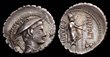
M. Junius Brutus. 54 BC. Silver Denarius (3.71g). Rome mint. BRVTVS, bearded head of L. Junius Brutus right / AHALA, bearded head of C. Servilius Ahala right. Crawford 433/2; Sydenham 907; Babelon (Junia) 31; RBW 1543. VF, with banker's mark on the reverse. Acquired from Leu Numismatik AG. (P)
| SOLD at A$625 | ||
| 10123 |
Q. Servilius Caepio Brutus (M. Junius Brutus). 54 BC. Silver Denarius (3.57g). Rome mint. Head of Libertas right / The consul L. Junius Brutus walking left between two lictors, each carrying axe over shoulder, preceded by an accensus. Crawford 433/1; Sydenham 906a; Junia 31a; RBW 1542. Lightly toned with lustre. aEF. Much finer than the most recent example sold in Triton XXIX, lot 5749 (13 Jan 2026), hammered US$1,600. Acquired from Emporium Hamburg in early 2019. (P)
| SOLD at A$1800 | ||
| 10124 |
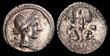
Julius Caesar. Dictator, 49-44 BC. Silver Denarius (3.70g, 18mm, 7h). Military mint travelling with Caesar in northern Italy, 49 BC. Elephant advancing right, trampling horned serpent / Pontifical implements: simpulum, aspergillum, securis and apex. Crawford 443/1; Sydenham 1006. aVF. Acquired from Heritage Auctions, Auction 231919, lot 62066 (9 May 2019), realised US$528. (P)
| SOLD at A$1350 | ||
| 10125 |
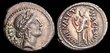
Julius Caesar. As Imperator and Dictator, 49-44 BC. Silver Denarius (3.79g). Uncertain mint, possibly Utica. DICT ITER COS TERT, head of Ceres right, wearing grain wreath / Emblems of the augurate and pontificate: simpulum, aspergillum, capis and lituus; AVGVR above, PONT MAX below, D. Crawford 467/1a; Sear 57; Sydenham 1023; RSC 4a. Lightly toned, very attractive and lustrous. aEF. A parallel issue replaces the M with a D, donativum meaning largesse, so both the M and D varieties were struck as payments to Caesar's veterans. For the type see; Heritage Auction 3082, lot 33201, hammered USD 1,300, though this coin is far superior in overall eye appeal and preservation to that example. (P)
| SOLD at A$2100 | ||
| 10126 |
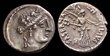
Julius Caesar. 49-44 BC. Silver Denarius (3.84g). Struck in Spain, circa 46-45 BC. Diademed head of Venus right, small Cupid at shoulder behind / CAESAR, trophy of Gallic arms between seated male and female captives. Crawford 468/1; RSC 13; Sear 1404. Lustrous. Superb example. gVF. This denarius was struck during Caesar's Spanish campaign of 46-45 BC, when he moved against the remaining Pompeian forces after the civil war had spread across the Roman world. Caesar's earlier conquest of Gaul, recorded in his Commentarii de Bello Gallico (Commentaries on the Gallic War), had transformed his wealth, reputation and military power. In 52 BC he defeated Vercingetorix and the Gallic coalition at Alesia, securing one of the defining victories of his career. The obverse links Caesar to Venus through the legendary line of Aeneas and Iulus, while the reverse, showing a trophy of Gallic arms between captives, advertises his victories in Gaul and presents them as proof of divine favour, military success and Roman dominance. For the type and a similar quality example, see Roma Numismatics Ltd., Auction 21, lot 457, hammered GBP 8,500. Acquired from Soler y Llach S.L., May 2019. (P)
| SOLD at A$2600 | ||
| 10127 |
Man. Acilius Glabrio. 49 BC. Silver Denarius (3.75g). Rome mint. Laureate head of Salus right / Valetudo (Salus) standing left, holding snake and leaning elbow on column. Crawford 442/1a; CRI 16; Sydenham 922; Acilia 8; RBW 1556. Beautiful blue and golden toning around the devices, giving the coin a very attractive appearance. gVF. This denarius was struck as Caesar's civil war opened, showing Salus on the obverse and Valetudo on the reverse, a pointed appeal to health, safety, and divine protection at a moment when the Roman state itself was falling ill. From the Titan Collection; acquired from Noble Numismatics, March 2001; previously ex Edward Gans, New York, circa 1957. (P)
| SOLD at A$425 | ||
| 10128 |
L. Hostilius Saserna. Moneyer issue of Imperatorial Rome, 48 BC. Silver Denarius (3.88g). Rome mint. Diademed female head (Pietas or Clementia?) right, wearing oak wreath / Victory advancing right, holding winged caduceus and trophy. Crawford 448/1a; CRI 17; Sydenham 951; Hostilia 5; RBW 1567. A very attractive old cabinet toning. A nice example for the type. gVF. This denarius uses a serene female head and the advancing Victory to promise mercy for the loyal and triumph over Caesar's enemies. In a time of uncertainty, it reassured Roman citizens that the winning side would bring both clemency and glory back to the Republic. From the David Allan Collection. For the type see; CNG Auction 118, lot 910, hammered USD 1,600. (P)
| SOLD at A$400 | ||
| 10129 |
Cnaeus Pompey Jr. Summer 46-spring 45 BC. Silver Denarius (3.62g). Corduba mint; Marcus Poblicius, legatus pro praetore. Helmeted head of Roma right within bead-and-reel border / Hispania standing right, shield on her back, holding two spears over shoulder and presenting palm frond to Pompeian soldier standing left on prow, armed with sword. Crawford 469/1a; CRI 48; Sydenham 1035; RSC 1 (Pompey the Great); RBW -. Old cabinet toning, with banker's mark. gVF. (P)
| SOLD at A$300 | ||
| 10130 |
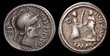
Julius Caesar. February to March 44 BC. Silver Denarius (3.77g). Rome mint. P. Sepullius Macer, moneyer. Wreathed head right / Venus Victrix standing left, holding Victory and sceptre resting on star. Crawford 480/11; Alfoldi Type VI; CRI 107b(1); Sydenham 1072; RSC 40; RBW 1684. aVF. Toned, with banker's marks. Acquired from CNG in early 2019; ex Kirk Davis FPL 19 (Summer 1997), no. 150, part of. (P)
| SOLD at A$1050 | ||
| 10131 |
Julius Caesar. Mid-March 44 BC. Silver Denarius (3.43g). Rome mint. P. Sepullius Macer, moneyer. CAESAR [DICT PERPETVO], wreathed and veiled head right / P SEPVLLIVS [MACER], Venus standing left, holding Victory and long sceptre; shield at base of sceptre. Crawford 480/13; CRI 107d; Sydenham 1074; Alfoldi Type IX; Babelon (Julia) 50, (Sepullia) 5. Good Fine. Lightly toned, slightly porous, with tiny scratches. Acquired from Nomos AG, lot 619 (3 Jul 2019), realised CHF 500. (P)
| SOLD at A$650 | ||
| 10132 |
C. Cassius Longinus and Lentulus Spinther. 43-42 BC. Silver Denarius (3.81g). Military mint moving with Brutus and Cassius. C CASSI IMP, LIBERTAS, diademed head of Libertas right / Jug and lituus; LENTVLVS SPINT below. Crawford 500/3; Sydenham 1307; Babelon (Cassia) 16 and (Cornelia) 75; Cohen 4; Sear Imperators 221; RBW 1762. About VF, with old cabinet toning. Scarce. Acquired from Naville Numismatics Ltd., Auction 51, lot 478 (21 Jul 2019), hammered GBP 230. (P)
| SOLD at A$350 | ||
| 10133 |
Mark Antony and Lepidus. The Triumvirs. May to summer 43 BC. Silver Quinarius (1.80g). Military mint travelling with Antony and Lepidus in Transalpine Gaul. Emblems of the augurate: lituus, capis and raven standing left / Emblems of the pontificate: simpulum, aspergillum, securis and apex. Crawford 489/3; CRI 120; Sydenham 1158a; King 73; RSC 3; RBW 1710. VF. This quinarius was struck in 43 BC, as Mark Antony and Lepidus moved with their forces in Transalpine Gaul, during the political and military manoeuvring that preceded the formal establishment of the Second Triumvirate. The obverse emblems of the augurate and the reverse emblems of the pontificate advertise their high priestly offices, underlining that their emerging political authority rested on Rome's sacred religious power. Rare and in unusually fine condition for the issue, with lovely old cabinet toning, this very rare quinarius is almost never encountered in such preservation, as most known examples of the type are of poor quality or far off-centre. The piece offered here is superbly struck, unusually well centred and with exceptionally clear detail, and is clearly one of the finest known examples of this elusive type, markedly superior in centering and overall appearance to the specimen sold in CNG Auction 561, lot 577 (1 May 2024), hammered USD 500. (P)
| SOLD at A$400 | ||
| 10134 |
Mark Antony. 43 BC. Silver Denarius (3.22g). Military mint in Cisalpine Gaul. M ANTON IMP, bearded head right; lituus behind / CAESAR DI[C], laureate head of Julius Caesar right; jug behind. Crawford 488/1; Sydenham 1165; Babelon (Antonia) 4 and (Julia) 54; Cohen 2; Sear Imperators 118; RBW 1708; Woytek, Arma et Nummi p. 558. Good Fine. Toned. Rare. Acquired from Naville Numismatics Ltd., Auction 51, lot 474 (21 Jul 2019), hammered GBP 360; from the M.J. Collection. (P)
| SOLD at A$1350 | ||
| 10135 |
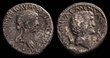
Lepidus and Octavian. The Triumvirs. November-December 43 BC. Silver Denarius (3.97g). Military mint travelling with Lepidus in Italy. Bare head of Lepidus right / Bare head of Octavian right. Crawford 495/2a; CRI 140; Sydenham 1323; RSC 2a; RBW 1752. Reverse off-centre, otherwise gVF for this very difficult issue. This coin marks the establishment of the Second Triumvirate. Lepidus appears with the title Pontifex Maximus, the chief priesthood he took on after Julius Caesar's assassination and continued to hold until his death in 12 BC. For the type see; Triton XVI, lot 965, hammered USD 26,000. (P)
| SOLD at A$2400 | ||
| 10136 |
C. Cassius Longinus. Spring 42 BC. Silver Denarius (3.99g). Military mint, probably at Smyrna. P. Cornelius Lentulus Spinther, legatus. Tripod surmounted by cortina and two laurel branches, fillet hanging on either side / Capis and lituus. Crawford 500/1; CRI 219; Sydenham 1308; RSC 7; RBW 1761. Lustrous, with amazing toning. EF. A very attractive piece. Issued in the tense months before Philippi, this denarius of C. Cassius Longinus quietly advertises Republican piety rather than open rebellion. The tripod crowned by the cortina and laurel branches evokes Apollo's oracular authority, a god Cassius hoped would favour his cause, while the capis and lituus on the reverse proclaim priestly legitimacy and traditional Roman religion amid civil war. For the type see; CNG Auction 130, lot 441, sold 23 September 2025, hammered USD 4,750. (P)
| SOLD at A$3300 | ||
| 10137 |
C. Cassius Longinus. The Republicans. Spring 42 BC. Silver Denarius (3.65g). Military mint, probably at Smyrna; P. Cornelius Lentulus Spinther, legatus. Veiled, diademed and draped bust of Libertas right / Capis and lituus. Crawford 500/5; CRI 223; Sydenham 1305; RSC 6; RBW 1764. aEF. An incredible pedigree. Crawford estimated that fewer than thirty obverse dies were employed for this rare and historically important issue. C. Cassius Longinus, one of the principal assassins of Julius Caesar, withdrew to the East after the Ides of March and rapidly rebuilt his power there. Drawing on his earlier successes against the Parthians as governor of Syria, he raised nearly twelve legions by 43 BC, defeated Antony's general Dolabella, secured Syria as his base, and even prepared for a projected invasion of Egypt. The formation of the triumvirate between Antony, Octavian and Lepidus, however, forced a change of plan. Cassius abandoned the Egyptian venture and marched west to join Brutus at Smyrna, where the two regicides coordinated their campaign by striking at the triumvirs' allies in Asia. The following year they advanced into Thrace and took up a defensive position near Philippi to await the armies of Antony and Octavian. In the ensuing battle, Brutus won a striking success against Octavian, capturing his camp, but Cassius' forces were routed by Antony. Not knowing of Brutus' victory, Cassius believed the entire cause was lost and ordered his freedman Pindarus to kill him, bringing his career to a tragic close. From the David Allan Collection, acquired from Noble Numismatics in November 1999; formerly a British Museum duplicate, donated in 1872 and subsequently deaccessioned; earlier ex Eton College Collection, Sotheby's, London, 1 December 1976, lot 417; and ex W. Woolmer, Sydney, November 1982, by exchange. (P)
| SOLD at A$2200 | ||
| 10138 |
Mark Antony. The Triumvirs. Early 42 BC. Silver Quinarius (1.57g). Lugdunum (Lyon) mint. Winged bust of Victory right, with the likeness of Fulvia; III VIR R P C / Lion walking right; ANTONI above, IMP in exergue, A to left, XL[I][ to right (= 41, Antony's age at the time of issue). Crawford 489/6; RPC Online 513.35 (this coin); CRI 126; Sydenham 1163; Lyon 3; King 76; RSC 3 (Fulvia); DCA 941; RBW 1713. Toned. VF, exceptional for the type. (P)
| SOLD at A$325 | ||
| 10139 |
Brutus. Spring to early summer 42 BC. Silver Denarius (3.73g, 12h). Military mint travelling with Brutus and Cassius in the East. L. Sestius, proquaestor. Veiled and draped bust of Libertas right; L SESTI PRO Q around / Tripod; securis to left, simpulum to right, Q CAEPIOBRVTVS PRO COS around. Crawford 502/2; CRI 201; RSC 11; Sydenham 1290; Kestner 3772; BMCRR East 41-5; RBW 1768. Sharply struck, nicely toned and very well preserved, a very attractive example overall and certainly one of the finest known for the type. EF. This usually rough and hasty coinage was struck for the army of L. Sestius Quirinalis, the son of a Pompeian officer who later cast his lot with the assassins of Caesar. After the defeat of Brutus, Sestius managed the delicate task of securing Octavian's pardon and, remarkably, rose high enough to serve as consul in 23 BC. He is not just a name on a coin, as he also lives on in literature as the man to whom Horace addressed one of his odes, giving this issue a direct link to both the battlefield and the world of Augustan poetry. The other protagonist behind this type, Marcus Junius Brutus, followed a career that in many respects paralleled that of his fellow conspirator Cassius. A pardoned Pompeian, he enjoyed special favour from Caesar, who appointed him governor of Cisalpine Gaul in 46 BC and urban praetor two years later. Despite these honours, Brutus became one of the ringleaders in Caesar's assassination and, after the deed, fled Rome. Rejecting the province legally assigned to him, he instead seized control of Greece, where he assembled troops and raised money until the Senate retroactively legalised his actions in February 43 BC by granting him the command of Illyria, Macedonia and Achaea. Although allied with Cassius, he campaigned separately in order to maximise revenues for the Republican cause until the two finally combined forces in the summer of 42 BC for the fatal confrontation with Antony and Octavian at Philippi, where defeat drove Brutus to take his own life. This denarius, which employs his adoptive name Q. Caepio Brutus and styles him proconsul, thus encapsulates the complex alliance between Brutus and Sestius and serves as a direct contemporary witness to the desperate last phase of the Republican resistance. For the most comparable example in both type and condition to the present coin, see Triton XX, lot 559, hammered USD 7,000. From the Titan Collection; previously from the David Allan Collection, acquired from Noble Numismatics Sale 48 (11-13 Jul 1995), lot 2998. (P)
| SOLD at A$3600 | ||
| 10140 |
Octavian. Silver Denarius (3.65g). Military mint travelling with Octavian in Greece, autumn 42 BC. Helmeted and draped bust of youthful Mars right; spear over left shoulder; CAESAR III VIR R P C around / Aquila between two signa, all on ground line; trophy above with oval shields; S C flanking aquila. Crawford 497/3; CRI 138; RSC 248; RBW 1758 (this coin). gVF, with attractive old cabinet toning and iridescent highlights. Acquired from Roma Numismatics E-Sale 64 (28 Nov 2019), lot 592, hammered GBP 500; ex Andrew McCabe Collection, ticket included; ex Richard B. Witschonke Collection, Numismatica Ars Classica Auction 63 (17 May 2012), lot 519; ex Dr. Busso Peus Nachfolger Auction 355 (27 Apr 1998), lot 246, part of. (P)
| SOLD at A$2700 | ||
| 10141 |
P. Clodius M.f. Turrinus. Moneyer issue of Imperatorial Rome. 42 BC. Silver Denarius (3.81g). Rome mint. Laureate head of Apollo right; lyre to left / Diana Lucifera standing right, bow and quiver over her shoulder, holding torches. Crawford 494/23; CRI 184; Sydenham 1117; Claudia 15; RBW 1727. A very attractive old cabinet toning with darker highlights. gVF. (P)
| SOLD at A$250 | ||
| 10142 |
Sextus Pompey. 43-35 BC. Bronze As (20.09g). Uncertain Sicilian mint. Struck circa 42-38 BC. MGN, laureate janiform head of Pompey the Great / PIVS IMP, prow of galley right. Crawford 479/1; CRI 336; Sydenham 1044; Babelon (Pompeia) 20; RBW 1675; Woytek p. 558 and pl. 11, 281. Good VF. Attractive dark green patina with a strong janiform double portrait. Acquired from Inasta S.p.A., early 2019. (P)
| SOLD at A$800 | ||
| 10143 |
Mark Antony and Octavian. Autumn 41 BC. Silver Denarius (3.72g). Military mint travelling with Antony (Ephesus?). M. Barbatius Pollio, quaestor pro praetore. Bare head of Antony right, with M ANT IMP AVG III VIR R P C and M BARBAT Q P around / Bare head of Octavian right, slightly bearded, with CAESAR IMP PONT III VIR R P C around. Crawford 517/2; CRI 243; Sydenham 1181; RSC 8a. VF, with graffiti or banker's marks on both sides. Acquired from Roma Numismatics Ltd., E-Sale 57 (30 May 2019), lot 777. (P)
| SOLD at A$725 | ||
| 10144 |
Mark Antony and Octavian. Spring to early summer 41 BC. Silver Denarius (3.99g). Ephesus mint. M. Barbatius Pollio, quaestor pro praetore. Bare head of Mark Antony right / Bare head of Octavian right. Crawford 517/2; CRI 243; Sydenham 1181; RSC 8; RBW 1798 var. Struck on a very broad flan, with very attractive toning and lustre. aEF. This denarius was struck in the tense years after Caesar's assassination, when the Roman world was split between rival armies and fragile alliances. This little silver piece was propaganda in metal, showing both men on opposite sides to reassure soldiers and citizens that the alliance of the Caesarians still held firm. In reality, their partnership would soon collapse into one of history's most famous power struggles, but for a brief moment this denarius symbolised a promised unity that never truly lasted. For the type see; CNG Auction 126, lot 629, the most recent similar example, hammered USD 2,750. (P)
| SOLD at A$2400 | ||
| 10145 |
Mark Antony and Octavia. Summer to autumn 39 BC. Silver Cistophorus (11.44g). Ephesus mint. Conjoined heads right of Antony, wearing ivy wreath, and Octavia / Dionysus standing left on cista mystica, holding cantharus and thyrsus, flanked by intertwined serpents. CRI 263; Sydenham 1198; RSC 3; RPC I 2202. aVF. Struck at Ephesus in 39 BC, this cistophorus reflects the short moment when Antony's marriage to Octavia was used to project unity in the Roman world. Dionysus, Antony's favoured divine patron, appears with the cista mystica and serpents, a strong eastern badge of authority and personal identity. Acquired from Classical Numismatic Group, Inc., 17 July 2019. (P)
| SOLD at A$625 | ||
| 10146 |
Mark Antony and Octavia. Summer to autumn 39 BC. Silver Cistophorus (11.47g). Ephesus mint. Head of Antony right, wearing ivy wreath; lituus below, within ivy and flower wreath / Draped bust of Octavia right above cista mystica, flanked by intertwined serpents with heads erect. CRI 262; Sydenham 1197; RSC 2; RPC I 2201. aVF. Toned. Acquired from Classical Numismatic Group, Inc.; previously ex Colosseum Coin Exchange 101 (19 May 1998), lot 97. (P)
| SOLD at A$525 | ||
| 10147 |
Octavian and Mark Antony. Late 39 BC. Silver Quinarius (1.66g). Military mint travelling with Octavian in Gaul. Veiled and diademed head of Concordia right / Clasped right hands holding caduceus. Crawford 529/4b; King 81; CRI 304; Sydenham 1195; RSC 67a (Mark Antony); RBW 1818. gVF. Pleasing old cabinet toning, with excellent silver quality for the issue. This quinarius was struck while Octavian and Mark Antony briefly shared power, its veiled Concordia and clasped hands with caduceus expressing an official promise of harmony between uneasy partners in a fractured Republic. From the David Allan Collection; previously in the Gordon Marr Collection and earlier in the Richard A. Williams Collection, the noted cotton farmer and major collector of United States, Roman and world coins; ex Spink Nob. Pty Ltd, Auction 45B (15 July 1994), lot 1781. (P)
| SOLD at A$350 | ||
| 10148 |
Sextus Pompey. 37/6 BC. Silver Denarius (3.74g). Uncertain Sicilian mint. Bare head of Pompey the Great right; capis to left, lituus to right / Neptune standing left, holding aplustre and resting foot on prow, flanked by the Catanaean brothers Anapias and Amphinomus running in opposite directions, each bearing a parent. Crawford 511/3a; CRI 334; Sydenham 1344; RSC 17 (Pompey the Great); RBW 1785. aVF, with banker's marks. Acquired from Dr. Busso Peus Nachf.; ex Sammlung Prof. Bachmann, acquired 1999. (P)
| SOLD at A$675 | ||
| 10149 |
Sextus Pompey (The Pompeians). 37/6 BC. Silver Denarius (3.92g). Obverse brockage. Uncertain Sicilian mint. Bare head of Pompey the Great right; capis to left, lituus to right / Incuse and reversed impression of the obverse. Cf. Crawford 511/3a; cf. CRI 334; cf. Sydenham 1344; cf. RSC 17 (Pompey the Great); cf. RBW 1785. Amazing old cabinet toning. Quite possibly the finest known example of this denarius type, an absolutely superb brockage of exceptional eye appeal. In our opinion, it is markedly superior in strike, centering and overall preservation to the most recently sold specimen in CNG 596, lot 655 (1 Oct 2025), hammered USD 1,500, as well as to all other recorded auction examples of the type. (P)
| SOLD at A$2500 | ||
| 10150 |
Sextus Pompey. 37-36 BC. Silver Denarius (3.79g). Military mint in Sicily. MAG PIVS I[MP ITER], bare head of Pompeius Magnus right; jug behind, lituus before / [PRAEF] CLAS ET ORAE MARIT EX S C, Neptune standing left, holding aplustre and placing right foot on prow; the Catanaean brothers at left and right, each carrying a parent. Crawford 511/3a; CRI 334; Sydenham 1344; Babelon (Pompeia) 27. Struck off-centre, otherwise EF, with an amazing portrait. Acquired from Nomos AG, Obolos Web Auction 13, lot 621 (July 2019), realised CHF 360. The catalogue noted possible tooling, but on close inspection we see no convincing evidence of tooling, in our opinion. (P)
| SOLD at A$1050 | ||
| 10151 |
GAUL. Lugdunum (Copia). Octavian, as Imperator (43-27 BC), and Divus Julius Caesar. Bronze Dupondius (16.81g). Circa 36 BC. IMP CAESAR DIVI F DIVI IVLI, addorsed heads of laureate Divus Julius Caesar left and bare head of Octavian right; upright palm between / COPIA, prow of ship right, decorated with eye and dolphin right; globe and meta above. RPC 515; Giard 7. Very rare. Only four other known examples. gVF. An exceptionally attractive example of this normally crude and poorly struck issue, with perfect centring and two truly impressive portraits. This piece is markedly finer than the CGB.fr example (sale, 20 August 2024, lot 930923, which realised the equivalent of about USD 885) and clearly superior to most other recent offerings, placing it among the finest known specimens of the type. From the collection of David Allan and previously from the Roy Sansom Collection, Sydney, sold circa 1973, and previously from the B. R. Noble Collection; Glendining & Co., London, 11 December 1975, lot 145, and Spink, 1930s. (P)
| SOLD at A$1050 | ||
| 10152 |
Octavian. The Triumvirs. Spring to early summer 36 BC. Silver Denarius (3.81g). Southern or central Italian mint. Bare head right, with slight beard / Tetrastyle temple of Divus Julius: statue of Julius Caesar as augur standing within, DIVO IVL on architrave, star within pediment, figures along roof line; lighted altar to left. Crawford 540/2; CRI 315; Sydenham 1338; RSC 90; RBW 1829. Obverse slightly off-centre, otherwise lightly toned with hints of golden hues. gVF. This denarius was struck as Octavian fought to tighten his grip on Rome, turning the memory of Julius Caesar into his strongest ally. The temple of Divus Julius, crowned with the star of the deified dictator and a burning altar beside it, publicly links Octavian's cause with divine favour. In this small silver piece, Romans were gently reminded that supporting Octavian meant honouring the godlike Julius, and resisting him meant standing against Caesar himself. (P)
| SOLD at A$1600 | ||
| 10153 |
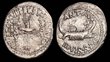
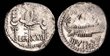
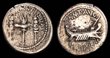
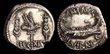
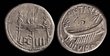
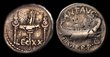
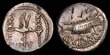
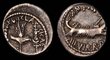
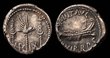
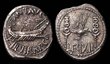
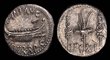
Mark Antony. 43-30 BC. Silver Legionary Denarius (3.67g). Military mint moving with Antony, 32-31 BC. War galley under oar / Aquila between two standards; LEG XVII in exergue. Crawford 544/33; RSC 51. EF. Toned, with uneven strike. Rare. From the Titan Collection; acquired from Agora Auctions, Sale 95, lot 135 (4 Feb 2020), hammered US$500. (P)
| SOLD at A$800 | ||
| 10154 |
Mark Antony and Cleopatra. Autumn 34 BC. Silver Denarius (2.74g). Alexandria mint (?). Bare head of Mark Antony right; Armenian tiara to left, ANTONI ARME[NIA DEVICTA] around / Diademed and draped bust of Cleopatra right; at point of bust, prow right; CLEOPATRAE REGINAE REGVM FILIORVM REGVM around. Crawford 543/1; CRI 345; Sydenham 1210; RSC 1; BMCRR East 179-81; cf. Kestner 3836; RBW 1832. Toned. gF. The consensus of opinion on the date and mint of this coin was relatively uniform until the publication of R. Newman's A Dialogue of Power in the Coinage of Antony and Octavian, AJN 2 (1990), pp. 37-64. Sear, CRI, follows Newman in calling it an issue from Alexandria, struck for Antony's Armenian triumph in the autumn of 34 BC, when the celebrated and enigmatic Donations of Alexandria took place. Newman states that the coinage must belong to 34 BC, the year of Antony's Alexandrian triumph, since it would otherwise lack context. The legends may be translated as: of Antony, Armenia conquered, for Cleopatra, Queen of Kings and of her sons, kings. The Armenian crown behind Antony represents his victorious Roman army, and the prow beneath Cleopatra, which appears on no other Roman coin of hers, stands for the mighty Egyptian fleet; combined, they symbolise the full array of forces that Antony would soon marshal against Octavian. Acquired from MA-Shops; previously with CGB Numismatics, France. (P)
| SOLD at A$700 | ||
| 10155 |
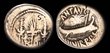
Mark Antony. 32-31 BC. Silver Legionary Denarius (3.11g). Military mint moving with Antony. ANT AVG III VIR R P C, praetorian galley right / LEG XVIII LYBICAE AVG, aquila between two standards. CRI 375 var. (obverse legend); Crawford 544/11 var.; RSC 53 var.; Sydenham 1240 var.; RBW 1836 var. VF, with banker's mark on the obverse. Apparently unpublished variant, adding AVG to the reverse legend, on an exceptionally rare legion type. Acquired from Roma Numismatics Ltd., E-Sale 72, lot 897 (25 Jun 2020), hammered AUD 1,434. (P)
| SOLD at A$475 | ||
| 10156 |
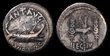
Mark Antony. 32-31 BC. Silver Legionary Denarius (3.28g). Military mint moving with Antony, autumn 32 to spring 31 BC. ANT AVG III VIR R P C, praetorian galley right / Aquila between two signa; LEG XXII across fields. Crawford 544/38; CRI 382; RSC 59. VF. Acquired from Roma Numismatics Ltd., E-Sale 60 (1 Aug 2019), realised GBP 160. (P)
| SOLD at A$325 | ||
| 10157 |
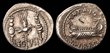
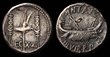
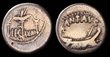
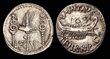
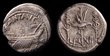
Mark Antony. 32-31 BC. Silver Legionary Denarius (3.46g). Military mint moving with Antony, perhaps Patrae. ANT AVG III VIR R P C, praetorian galley right / Aquila between two standards; LEG XVII ANTIQVAE across fields. Crawford 544/9; CRI 363. VF. Rare. Acquired from Roma Numismatics Ltd., E-Sale 19 (1 Aug 2015), lot 578. (P)
| SOLD at A$350 | ||
| 10158 |
Mark Antony. Autumn 32 to spring 31 BC. Silver Denarius (3.63g). Patrae (?) mint. Praetorian galley right / Aquila between two standards; CHORTIVM PRAETORIARVM around above. Crawford 544/8; CRI 385; Sydenham 1213; RSC 7. Good VF, with bright surfaces, slightly off-centre on the obverse, and on excellent metal for the issue. Among the rarest in the series. The praetorian cohorts take their name from the praetorium, or tent, of the commander. These elite troops went on campaign as the personal escort of their generals. Mark Antony likely had four or more praetorian cohorts with him at Actium. For the same type and a similar quality example, see CNG Auction 105, lot 773 (10 May 2017), hammered US$5,500. The present coin was acquired from CGB Numismatics, France, July 2020.
| SOLD at A$2900 | ||
| 10159 |
Mark Antony. Autumn 32 to spring 31 BC. Silver Denarius (3.71g). Patrae (?) mint. Praetorian galley right / Three signa decorated with wreaths and rostra; CHORTIS SPECVLATORVM around above. Crawford 544/12; CRI 386; Sydenham 1214; RSC 6; RBW 1837. gVF. Toned. Rare. An amazing piece. Serving as scouts, couriers and intelligence gatherers, the speculatores, sometimes referred to collectively as a cohors speculatorum, functioned as a legion's eyes and ears, moving ahead of the main force, carrying messages and quietly collecting information in the field. They are often described in the sources as a small detachment attached to each legion, commonly counted at around ten men and chosen for reliability and speed. Mark Antony is said to have expanded this idea by maintaining a dedicated body of speculatores around his own headquarters, men who operated directly under his personal authority, delivered sensitive orders, handled discreet missions and helped safeguard his person, in effect a rudimentary 'secret service' built on military discipline and loyalty. Under Augustus and the early emperors, this kind of personal intelligence and protective role was refined and more clearly tied to the imperial court, with specialised agents and guard elements increasingly serving the security and communications needs of the princeps. Acquired from CNG Auction 468 (20 May 2020), lot 346, realised US$1,100; from the Jonathan P. Rosen Collection; ex CNG Auction 100 (7 Oct 2015), lot 1827. (P)
| SOLD at A$1700 | ||
| 10160 |
Mark Antony. Autumn 32 to spring 31 BC. Silver Legionary Denarius (3.16g). Military mint moving with Antony, perhaps Patrae. ANT AVG, III VIR R P C, galley right; banker's mark above / Aquila between two standards; LEG II in exergue. Crawford 544/14; CRI 349; Sydenham 1216; Babelon (Antonia) 105. gVF. Toned and clear. Acquired from Nomos Auction 13, lot 622 (3 Jul 2019), hammered CHF 280; from The Vineyard Collection, Part II. (P)
| SOLD at A$625 | ||
| 10161 |
Mark Antony. Autumn 32 to spring 31 BC. Silver Legionary Denarius (3.26g). Patrae (?) mint. Praetorian galley right / Aquila between two signa; LEG XIIII across lower field. Crawford 544/28; CRI 370; Sydenham 1233; RSC 43. Very attractive old cabinet toning. gVF for the type. For a similar quality example of the same type see; CNG Auction 525, lot 851, hammered US$650. Not to be confused with a similar legion under the command of Octavian, this Antonian legion was either disbanded or incorporated into another legion after Actium. A rare legion, and rarer than the LEG XIV variety. Acquired from Aureo & Calico S.L., 16-17 Oct 2019. (P)
| SOLD at A$500 | ||
| 10162 |
Mark Antony. Autumn 32 to spring 31 BC. Silver Legionary Denarius (3.37g). Patrae (?) mint. Praetorian galley right; ANT AVG above, III VIR R P C below / Aquila between two signa; LEG XVIII LYBICAE above. Crawford 544/11; CRI 375; Sydenham 1240; RSC 53; BMCRR (East) 225; RBW 1836. VF. Among the scarcer legionary issues. (P)
| SOLD at A$475 | ||
| 10163 |
Mark Antony. Autumn 32 to spring 31 BC. Silver Legionary Denarius (3.49g). Patrae (?) mint. Praetorian galley right; ANT AVG above, III VIR R P C below / Aquila between two standards; LEG XII across lower field. Crawford 544/26; CRI 365; Sydenham 1230; RSC 41; BMCRR (East) 204; Kestner 3855. VF, with small banker's marks. Acquired from Soler y Llach S.L., Auction 1108 (Floor Auction), lot 388 (9 May 2019). (P)
| SOLD at A$275 | ||
| 10164 |
Mark Antony. Autumn 32 to spring 31 BC. Silver Legionary Denarius (3.50g). Military mint moving with Antony. ANT AVG III VIR R P C, praetorian galley right / Aquila between two standards; LEG XVI across fields. Crawford 544/31; CRI 372; Sydenham 1236; RSC 48; BMCRR (East) 211. VF. Acquired from Roma Numismatics Ltd., E-Sale 60, lot 706 (1 Aug 2019), realised GBP 300. (P)
| SOLD at A$425 | ||
| 10165 |
Mark Antony. Autumn 32 to spring 31 BC. Silver Legionary Denarius (3.57g). Military mint moving with Antony. ANT AVG III VIR R P C, praetorian galley right / Aquila between two standards; LEG VI across fields. Crawford 544/19; CRI 356; RSC 33. aEF, well centred, with attractive old collection toning. Acquired from Roma Numismatics Ltd., E-Sale 60, lot 704 (1 Aug 2019), hammered GBP 320. (P)
| SOLD at A$675 | ||
| 10166 |
Mark Antony. Autumn 32 to spring 31 BC. Silver Legionary Denarius (3.63g). Military mint moving with Antony. ANT AVG III VIR R P C, galley right, with sceptre tied with fillet on prow / Aquila between two standards; LEG III in exergue. Crawford 544/15; Sydenham 1217; Babelon (Antonia) 106; Cohen 28; Sear Imperators 350; RBW 1839. gVF, with banker's mark on the obverse. Acquired from Naville Numismatics Ltd., Auction 51, lot 482 (21 Jul 2019), realised GBP 220. (P)
| SOLD at A$750 | ||
| 10167 |
Mark Antony. Autumn 32 to spring 31 BC. Silver Legionary Denarius (3.65g). Patrae (?) mint. Praetorian galley right; ANT AVG above, III VIR R P C below / Aquila between two signa; LEG XXI across lower field. Crawford 544/37; CRI 381; Sydenham 1244; RSC 58; BMCRR (East) 216; Kestner 3865. gVF. Acquired from Ibercoin. (P)
| SOLD at A$375 | ||
| 10168 |
Mark Antony, autumn 32 to spring 31 BC. Silver Legionary Denarius (3.65g). Patrae(?). Praetorian galley right / Aquila between two signa; LEG XXIII across lower field. Crawford 544/39; CRI 383; Sydenham 1246; RSC 60. Fine, toned, struck slightly off center. Aquired from CNG Auction 447 (3 Jul 2019), lot 434, hammer 160 USD. (P)
| SOLD at A$190 | ||
| 10169 |
Mark Antony. Autumn 32 to spring 31 BC. Silver Legionary Denarius (3.66g). Patrae (?) mint. ANT AVG, III VIR R P C, praetorian galley right / Aquila between two standards; LEG V in exergue. Crawford 544/18; CRI 354; Sydenham 1221. VF, with banker's marks on the obverse. Acquired from Nomos Auction 13, lot 623 (3 Jul 2019), hammered CHF 200; from The Vineyard Collection, Part II. (P)
| SOLD at A$575 | ||
| 10170 |
Mark Antony. Autumn 32 to spring 31 BC. Silver Legionary Denarius (3.65g). Patrae (?) mint. Praetorian galley right / Aquila between two signa; LEG XXIII across lower field. Crawford 544/39; CRI 383; Sydenham 1246; RSC 60. Fine, toned, struck slightly off-centre. Acquired from CNG Electronic Auction 447 (3 Jul 2019), lot 434, hammered USD 160. (P)
| SOLD at A$625 | ||
| 10171 |
Mark Antony. Autumn 32 to spring 31 BC. Silver Legionary Denarius (3.72g). Military mint moving with Antony. ANT AVG III VI[R R P C], praetorian galley right / Aquila between two standards; LEG III across fields. Crawford 544/15; CRI 350; RSC 28. aVF, with banker's mark. Acquired from Roma Numismatics Ltd., E-Sale 57, lot 783 (30 May 2019), realised GBP 190. (P)
| SOLD at A$350 | ||
| 10172 |
Mark Antony. Autumn 32 to spring 31 BC. Silver Legionary Denarius (3.77g). Patrae (?) mint. Praetorian galley right; ANT AVG above, III VIR R P C below / Aquila between two signa; LEG XX across lower field. Crawford 544/36; CRI 380; Sydenham 1243; RSC 57; BMCRR (East) 215; Kestner 3864; RBW 1848. aVF. Acquired from Artemide Aste s.r.l., E-Auction 10, lot 292. (P)
| SOLD at A$425 | ||
| 10173 |
Mark Antony. Autumn 32 to spring 31 BC. Silver Legionary Denarius (3.81g). Military mint moving with Antony. ANT AVG III VIR R P C, galley right, with sceptre tied with fillet on prow / Aquila between two standards; LEG X in exergue. Crawford 544/24; Sydenham 1228; Babelon (Antonia) 117; Cohen 38; Sear Imperators 361. Amazing old cabinet toning; banker's marks on the obverse. gVF. Acquired from Naville Numismatics Ltd., Auction 62, lot 397 (13 Dec 2020); from a European collection; ex Fontana Collection, 1971. (P)
| SOLD at A$350 | ||
| 10174 |
Mark Antony, autumn 32 to spring 31 BC. Silver Legionary Denarius (3.82g). Military mint moving with Antony. ANT AVG III VIR R P C, praetorian galley right / Aquila between two standards; LEG XV across fields. Crawford 544/30; CRI 371; RSC 47. VF. Acquired from Roma Numismatics Ltd., E-Sale 57, lot 789 (30 May 2019). (P)
| SOLD at A$300 | ||
| 10175 |
Mark Antony. Autumn 32 to spring 31 BC. Silver Legionary Denarius (3.83g). Military mint moving with Antony. ANT AVG III VIR R P C, praetorian galley right / Aquila between two standards; LEG XVII across fields. Crawford 544/32; CRI 374; RSC 49. EF, with beautiful toning. Rare. Acquired from Roma Numismatics Ltd., E-Sale 76, lot 924 (5 Nov 2020), realised GBP 700; ex F.W., Bonn Collection. (P)
| SOLD at A$1000 | ||
| 10176 |
Mark Antony. Autumn 32 to spring 31 BC. Silver Legionary Denarius (3.84g). Military mint moving with Antony. ANT AVG III VIR R P C, praetorian galley right / Aquila between two standards; LEG VIII across fields. Crawford 544/21; CRI 358; Sydenham 1225; RSC 35; BMCRR (East) 199. VF. Acquired from Roma Numismatics Ltd., E-Sale 57, lot 785 (30 May 2019), realised GBP 160. (P)
| SOLD at A$325 | ||
| 10177 |
Mark Antony. Autumn 32 to spring 31 BC. Silver Legionary Denarius (3.89g). Patrae (?) mint. Praetorian galley right; ANT AVG above, III VIR R P C below / Aquila between two signa; LEG XI across lower field. Crawford 544/25; CRI 362; Sydenham 1229; RSC 39; BMCRR (East) 203; Kestner 3854. VF, struck over an earlier coin, with undertype visible, attractive cabinet toning and light golden iridescence. Acquired from Aureo & Calico S.L., Auction 337, lot 32 (16-17 Oct 2019), hammered EUR 180. (P)
| SOLD at A$425 | ||
| 10178 |
Mark Antony. Autumn 32 to spring 31 BC. Silver Legionary Denarius (3.90g). Patrae (?) mint. Praetorian galley right / Aquila between two signa; LEG XVII CLASSICAE above. Crawford 544/10; CRI 362; Sydenham 1229; RSC 39. aVF. Lightly toned. Very rare as such. This denarius names Legio XVII Classicae, a title pointing to special naval duties within Antony's war machine as Actium approached, when fleets and supply lines mattered as much as battlefield legions. After Antony's defeat, Octavian absorbed and reshaped these forces, and the number XVII later became infamous as one of the three legionary numbers destroyed in the Teutoburg Forest in A.D. 9, a disaster so traumatic that the number was never used again. (P)
| SOLD at A$600 | ||
| 10179 |
Mark Antony. Autumn 32 to spring 31 BC. Silver Legionary Denarius (3.90g). Patrae (?) mint. Praetorian galley right; ANT AVG above, III VIR R P C below / Aquila between two signa; LEG XIX across lower field. Crawford 544/35; CRI 378; Sydenham 1242; RSC 55; BMCRR (East) 214; Kestner 3863; RBW 1847. VF. (P)
| SOLD at A$250 | ||
| 10180 |
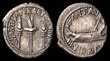
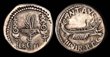
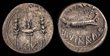
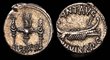
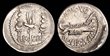
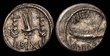
Mark Antony. 32-31 BC. Silver Legionary Denarius (3.82g). Military mint travelling with Antony, perhaps Patrae. ANT AVG, III VIR R P C, galley right / Aquila between two standards; LEG IX in exergue. Crawford 544/23. Wonderful old grey cabinet toning. Superb example. gVF. Acquired from Numismatik Naumann GmbH, lot 384 (7 Oct 2019), hammered EUR 325. (P)
| SOLD at A$1400 | ||
| 10181 |
Mark Antony. The Triumvirs. Autumn 32 to spring 31 BC. Silver Denarius (3.42g). Legionary issue. Patrae (?) mint. Praetorian galley right / Aquila between two signa; LEG XII across lower field. Crawford 544/26; CRI 365; Sydenham 1230; RSC 41. Old cabinet toning. gVF. (P)
| SOLD at A$550 | ||
| 10182 |
Mark Antony. The Triumvirs. Autumn 32-spring 31 BC. Silver Denarius (3.44g). Legionary type. Patrae (?) mint. Praetorian galley right / Aquila between two signa; LEG V across lower field. Crawford 544/18; CRI 354; Sydenham 1221; RSC 32; RBW 1840. Wonderfully toned. gVF. This denarius was struck as Mark Antony gathered his legions for the final showdown with Octavian, its war galley and legionary standards serving as hard silver propaganda for the power and loyalty of LEG V on the eve of Actium. (P)
| SOLD at A$800 | ||
| 10183 |
Mark Antony. Autumn 32-spring 31 BC. Silver Denarius (3.32g). Legionary type. Patrae (?) mint. Praetorian galley right / Aquila between two signa; LEG IIII across lower field. Crawford 544/16; CRI 353; Sydenham 1220; RSC 29; RBW -. Toned. aVF for the type. Acquired from Artemide Aste s.r.l., October 2019. (P)
| SOLD at A$425 | ||
| 10184 |
Mark Antony. Autumn 32 to spring 31 BC. Silver Denarius (3.41g). Legionary issue. Patrae (?) mint. Praetorian galley right; ANT AVG above, III VIR R P C below / Aquila between two signa; LEG IV across lower field. Crawford 544/17; CRI 352; Sydenham 1219; RSC 30; BMCRR East 195; RBW -. gF.
| SOLD at A$350 | ||
| 10185 |
Mark Antony. Autumn 32-spring 31 BC. Silver Denarius (3.11g). Legionary type. Patrae (?) mint. Praetorian galley right; ANT AVG above, III VIR R P C below / Aquila between two signa; LEG XII across lower field. Crawford 544/26; CRI 365; Sydenham 1230; RSC 41; BMCRR (East) 204; Kestner 3855; RBW -. VF for the type. (P)
| SOLD at A$300 | ||

| First | Previous | Next | Last | Index |